
Low-voltage switchgear manufacturer · Manufacturing
One-line idea → an AI quoting system in production in ~3 weeks
Our client manufactures low-voltage switchgear — electrical panels. They had no CRM and no tooling, only a hunch that AI might take some load off their director and engineer. We brought the engineering expertise to make it real: a role-based order pipeline, an 1,887-item catalogue, automatic pricing, and an AI assistant that reads client drawings — removing the pain end to end.
Inside the product
The gap
When the client came to us there was no system at all. Quotes were assembled by hand in Excel from an 85 MB, 20-sheet price list, the pricing formulas lived in one person's head, and the director had no view of the pipeline. The brief was a single sentence — could AI take some load off the engineer and director?
- No CRM: every order lived in someone's head and scattered files
- Quotes composed by hand in Excel across a 20-sheet, 85 MB price list
- Pricing and markup formulas locked in one person's memory
- The engineer buried in repetitive drawing-reading
- The director blind to where deals were and how much was in them
The insight
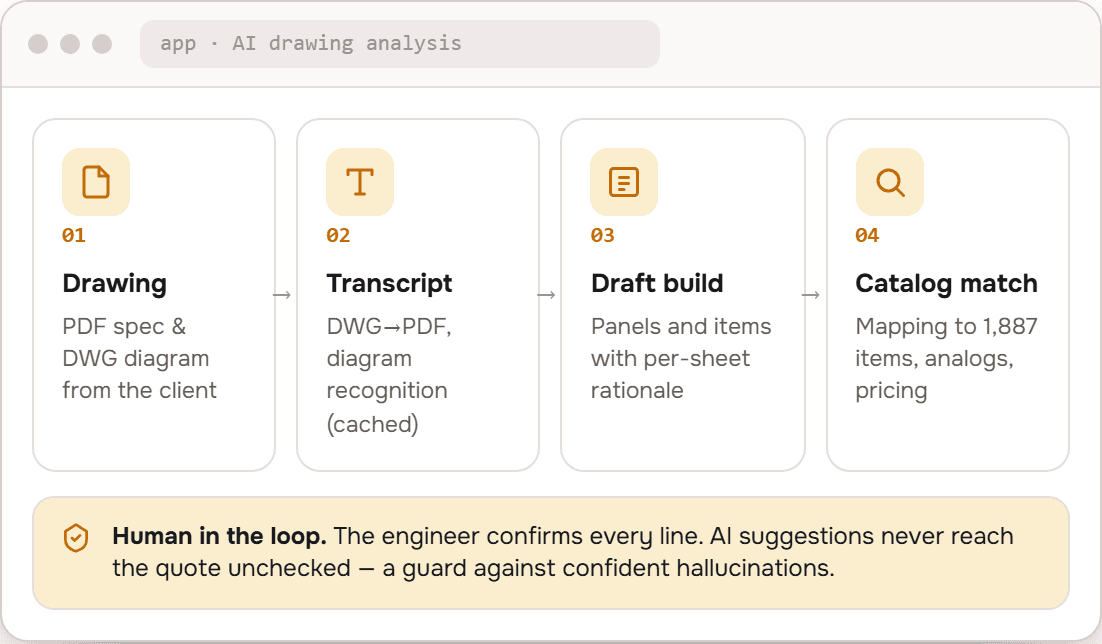
The ask was "add AI." The real problem was the absence of any system — and the true bottleneck was reading the drawings. If a vision model could interpret an engineering drawing, quoting and pricing could be automated end to end, with a human confirming every line so a confident hallucination never reaches a quote.
A product tour
- A full order pipeline with roles, statuses and audit
- Automatic pricing: materials → assembly → markup → VAT
- An AI assistant that drafts panel contents from client drawings
- Branded Quote & Specification documents, with Excel and print export
- A real-time ROI dashboard for the director
Order board — a role-based pipeline
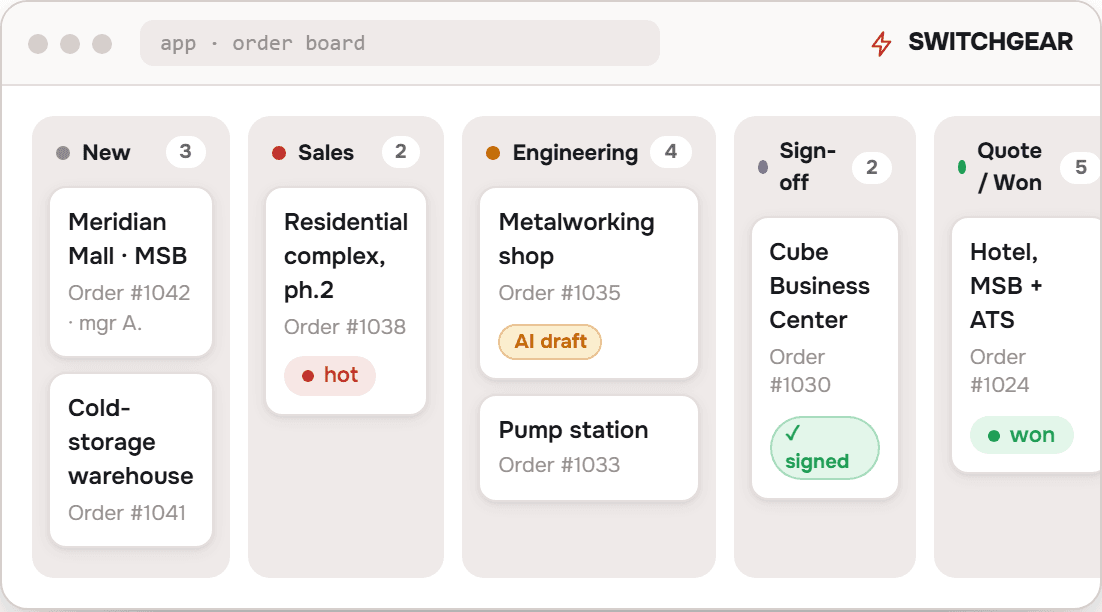
Every order sits on one kanban board by stage. Role and status decide what can change: the engineer edits panel contents only while the order is "Engineering," money is visible only to the manager, head of sales and director, and any stage can be sent back for rework with a required comment and full history.
Panel contents & automatic price
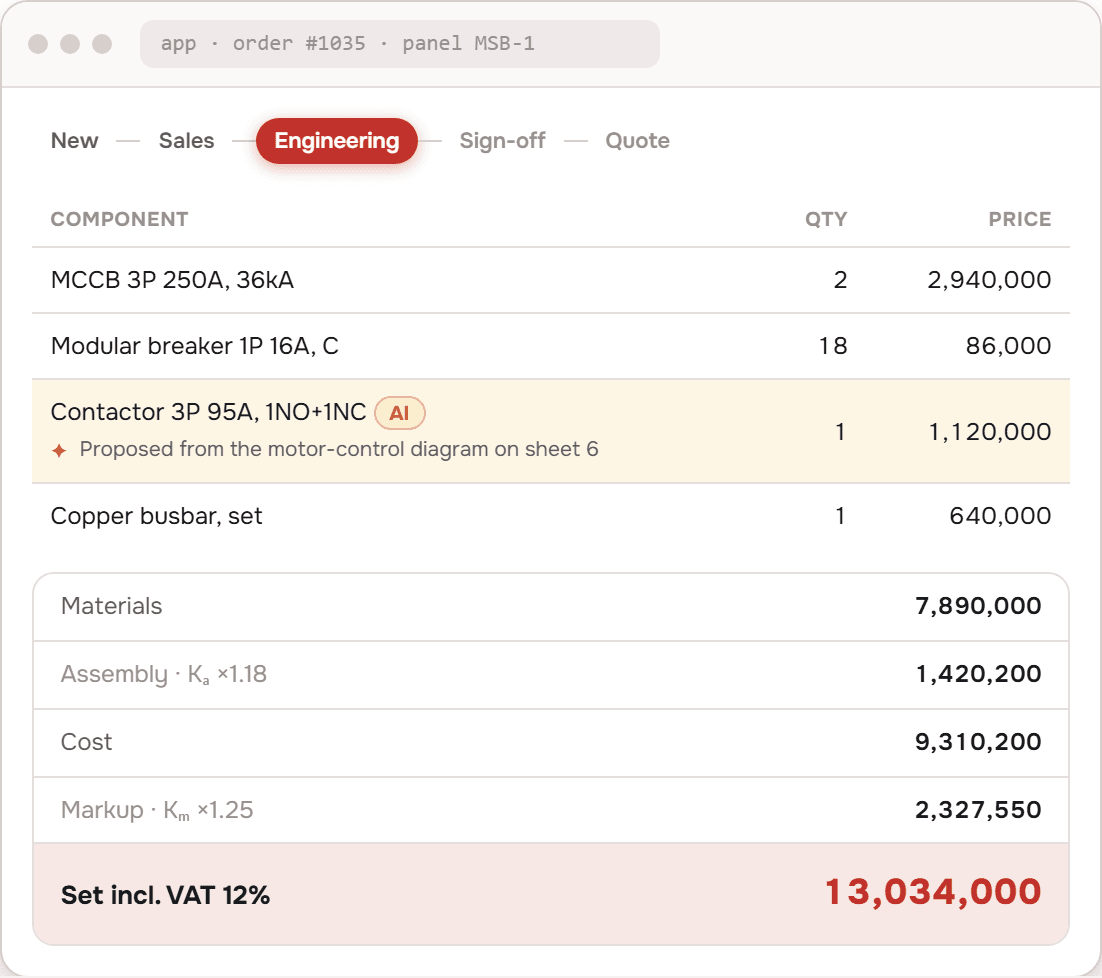
The engineer builds the panel from the catalogue and the system prices it with a transparent formula — materials → assembly coefficient (Kₐ) → cost → markup (Kₘ) → VAT. Markup is set per manufacturer; panel templates, cloning and a component usage counter speed the work. The engineer never sees money.
The engineer's AI assistant
Clients send PDF specs and DWG diagrams. The system converts them, reads them with a vision model, drafts the panel contents, maps them onto the 1,887-item catalogue by specs and analogs, and prices it. Every AI line is tagged with a rationale and a sheet reference; prompts are editable by the director in the admin panel; a human confirms every line.
A structured catalogue with analogs
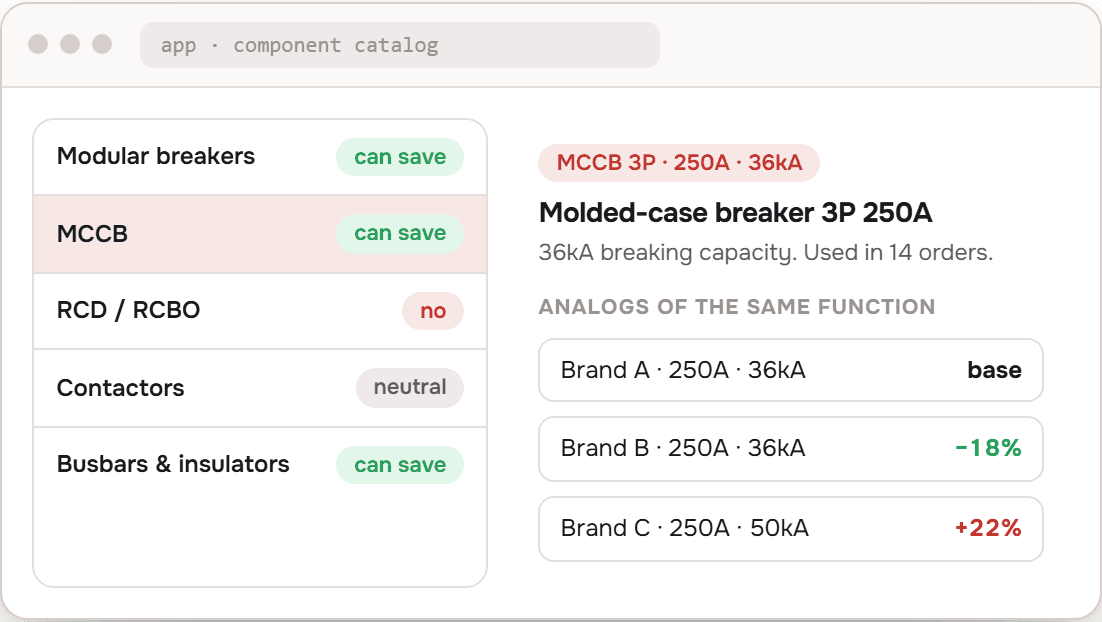
The 85 MB, 20-sheet price list imported into a structured catalogue: categories, series, specs, and 223 analog groups built by function (type · poles · rating · kA). Each category carries a risk flag for where a cheaper analog is safe, with the price Δ% shown right in the card and case-insensitive Cyrillic search.
Quote & Specification documents
The payoff — two branded documents. The Quote (panels, quantities, price, VAT, total) built exactly to the client's sample; the Specification (equipment and brands, no prices) for procurement. Excel export, PDF print, and every generation saved to a version history.
The director's dashboard
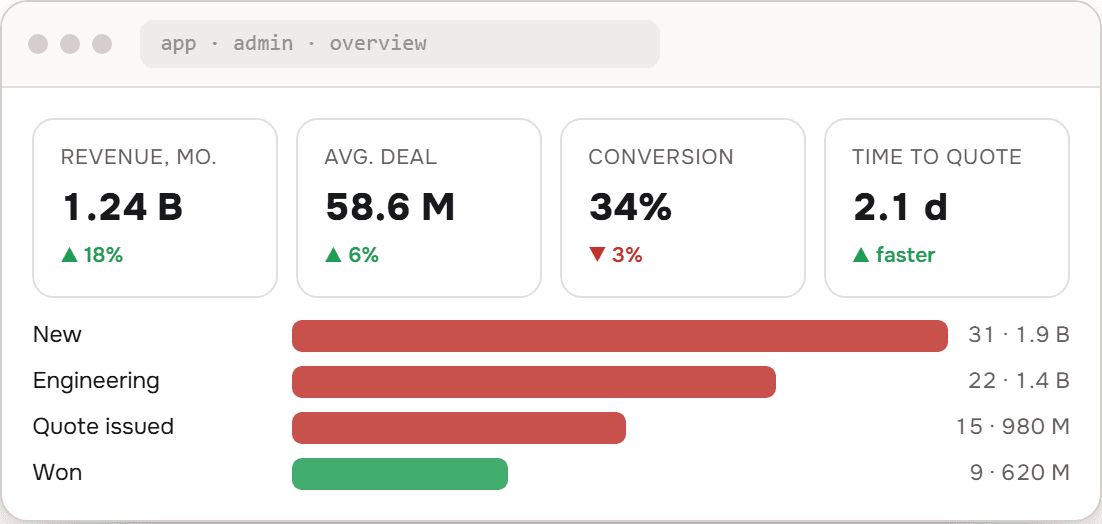
A dedicated screen for the owner: revenue, the funnel with amounts per stage, average deal, conversion, and stuck orders (clickable). Exactly what turns an internal tool into a management instrument.
Under the hood
A fully in-house build
Frontend, backend, database, AI pipeline, drawing converter, authentication and deployment — no external pricing services. All business logic is ours, with a tested pricing core, 25 DB migrations and 11 API modules.
The drawing pipeline
A React SPA served by nginx talks to an Express API on systemd; PostgreSQL 16 holds the data with a price snapshot and audit. QCAD runs headless to convert DWG→PDF (~40s/file), the vision model reads the result with structured output and tool-use over the catalogue, and file links are HMAC-signed for 6 hours.
How it went
Skeleton & foundation
DB schema, tested pricing core, order and contents API, a frontend skeleton with roles and the board. Catalogue imported from the 85 MB price list.
Catalogue, permissions, documents
Catalogue 2.0 with analogs and risk flags, per-brand markup, panel templates, Quote & Specification generation on a letterhead, Excel export, history and rework.
AI, security, production
AI drawing analysis, the DWG converter, real login with sessions, editable role permissions, the ROI dashboard, signed file links — and deployment on Ubuntu.
Stack & channels
Services behind this
The outcome
Manual quoting is gone, replaced by a tool the whole team uses — from manager to director. The director sees the pipeline, the engineer gets AI help, and quotes go out on a branded template. Shipped to the client's own server, issuing real documents. Interfaces shown are faithful product mockups; data anonymised.
Start a project
Tell us what's missing.
One form, a real reply within 24 hours. Or book a call directly.
Other ways to reach us
- Emailhello@thnkers.com
- LinkedIn@thnkers
- Book a callcalendly.com/thnkers