Talents Music School · Formazione musicale · Minneapolis, USA
0
calcoli manuali dei pagamenti in 2 sedi
Hanno chiesto un pulsante di pagamento. Noi abbiamo guardato cosa avevano davvero.
Gestire da soliSbloccare

Gestire da soli
More than half of Europe's small-business owners spend over 40% of their time on admin. Here is how to find your own number.
Gli articoli sono disponibili solo in inglese.
Ask a school director, a studio owner or the founder of a small service company how they spend their week, and the first answer is the work: teaching, designing, serving clients. Ask them to write it down hour by hour, and a different picture appears.
In 2024 Visma and Kantar surveyed 2,000 entrepreneurs across Europe (Visma and Kantar, 2024).
55%
The survey was commissioned by a software company, so treat it as an industry estimate. The direction is confirmed elsewhere. US private music teachers report 2.8 hours a week on bookkeeping and business tasks alone (MTNA, 2024). In a school with several teachers, much of that lands on the director.
On a 40-hour week, 40% is 16 hours. Two working days.
For one normal week, keep a running note. Every time you switch task, write down what you're doing and for how long. At the end of the week, sort the time into these categories:
Then mark each item in categories 2 to 6 with one of three letters:
Everything marked P and C is the first candidate to take off your desk.
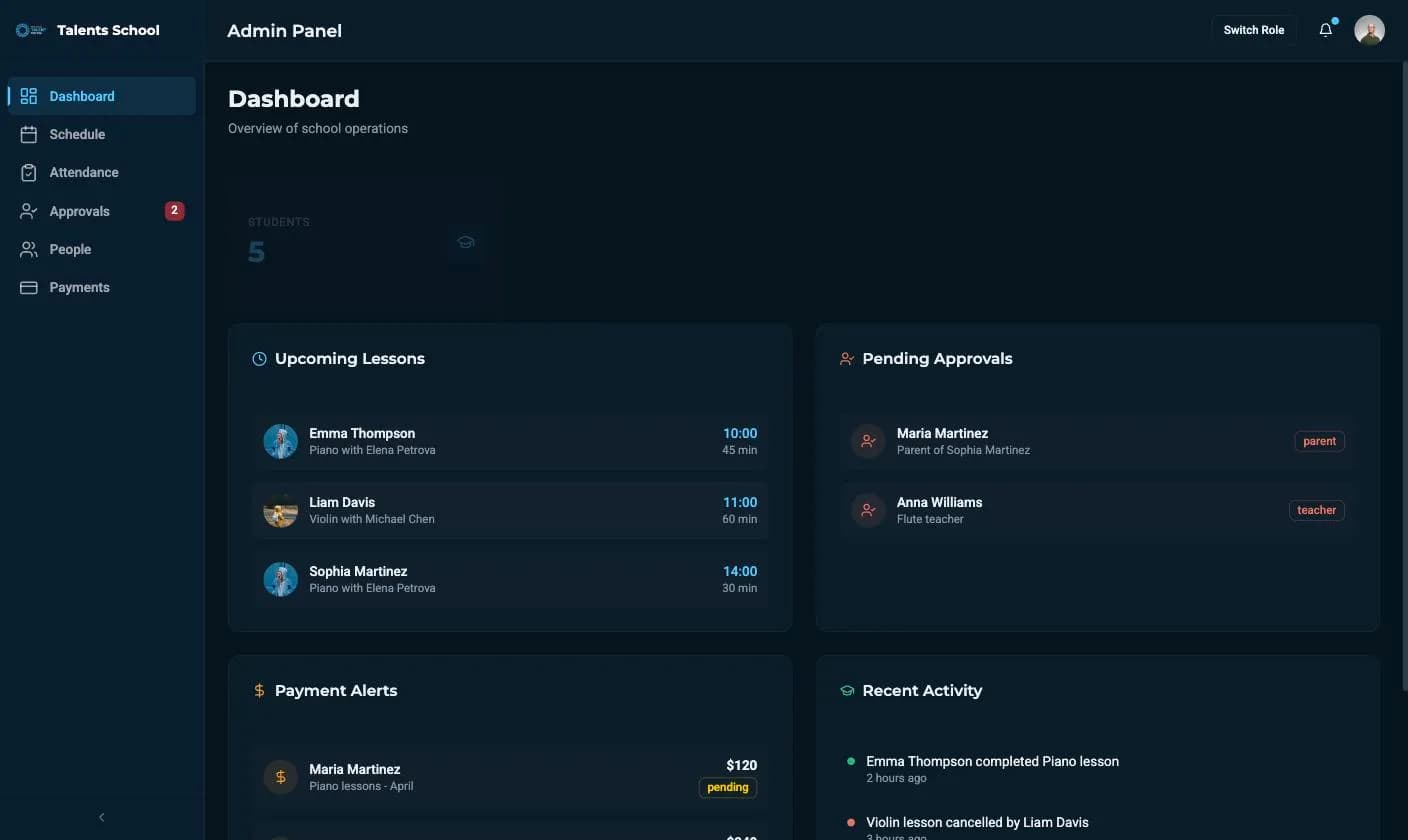
In the music school from our portfolio, the director was the switchboard. Teachers' schedules, students' lesson times, every reschedule, every payment check. Most of it was P and C.
After the system went live:
The director now spends at least a third less time on admin and messages, sometimes half. Work no longer goes home in the evening. The school opened a second location.
On a 16-hour admin week, a third to a half is roughly five to eight hours: about one working day. That is our arithmetic on a typical week, not the director's measurement.
The same Visma survey found that 46% of entrepreneurs put growth first and only 13% put efficiency first. That's worth remembering. The point of taking admin off your desk is not a tidier week. It is the hours to open a second location, take on more students or finally build the thing you keep postponing.
Owners of small businesses often assume systems are for large companies. The evidence says the opposite. McKinsey found that digital transformations in companies with fewer than 100 employees are 2.7 times more likely to succeed than in companies with more than 50,000 (McKinsey, 2018). Fewer people, fewer approvals, faster decisions.
Calcolatore dei costi
Related: Why we said no to the payment button · Missed lessons and moved lessons
Talents Music School · Formazione musicale · Minneapolis, USA
0
calcoli manuali dei pagamenti in 2 sedi
Gestite tutto a mano, e il collo di bottiglia siete voi.
Trenta minuti. Voi descrivete il problema e il risultato che volete. Noi facciamo domande. Se possiamo aiutarvi, ricevete una email con cosa abbiamo trovato, cosa costruiremmo e quanto costa. Se non possiamo, ve lo diciamo.
Non siete pronti a parlarne? Scoprite quanto vi costa il modo in cui lavorate oggi