Buyers don't believe brochures. They believe other owners. A dealer's community chat turned out to be its best sales asset.
Gli articoli sono disponibili solo in inglese.
A buyer about to spend $6,700 or more on a machine they have never seen has questions. Which model fits my jobs? What breaks? What does it cost to run? Can I register it? How do I haul it? A dealer's brochure answers none of them, and the buyer knows not to trust it anyway.
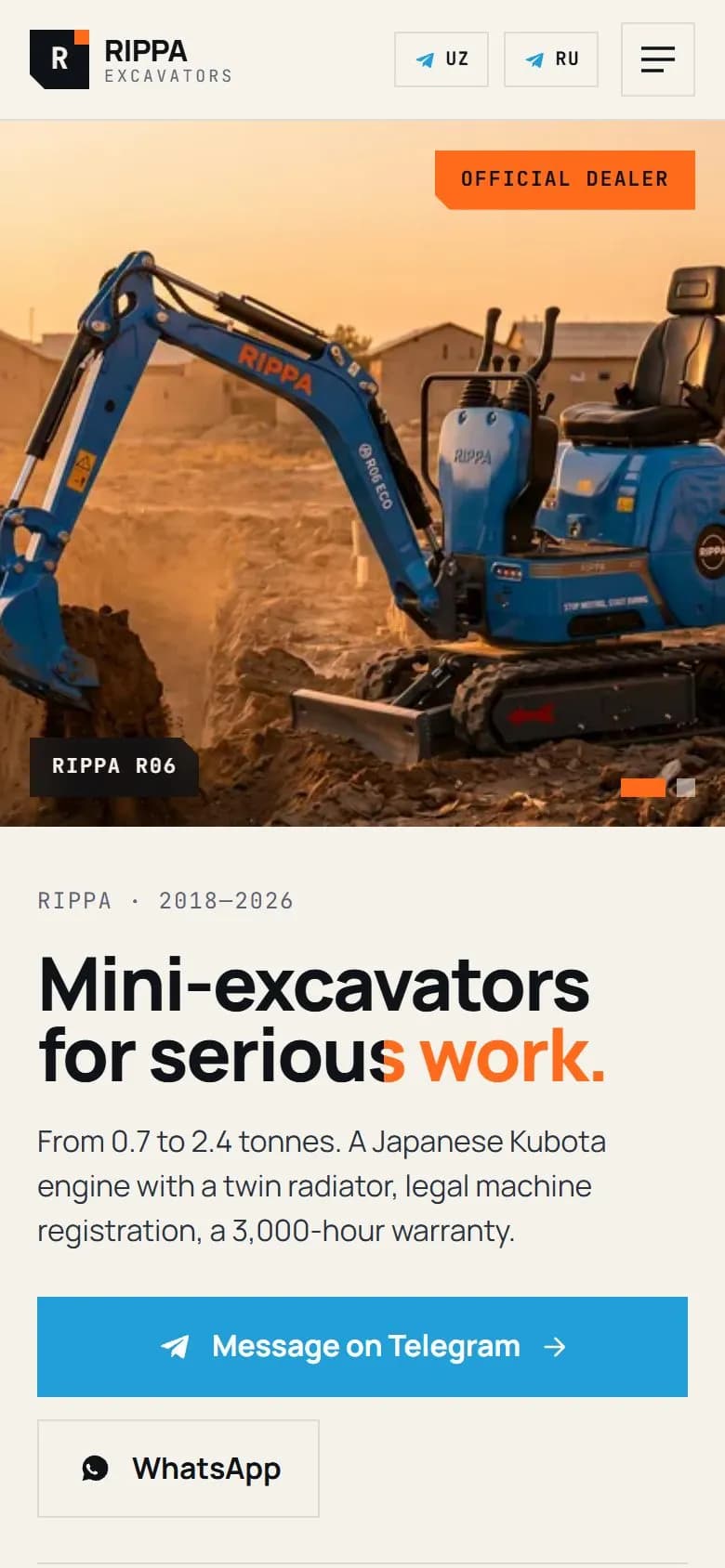
Rippa, a dealer of mini-excavators, had the answers. They were sitting in its owners' Telegram group: eight months of conversations, 383 owners, 57,494 messages. Nobody had turned them into a website.
66 to 72% of B2B buyers trust industry peers and independent experts (Forrester, 2025).
64 to 65% of decision-makers trust substantive expertise more than marketing material (Edelman and LinkedIn, 2025).
In the same study, 71% of the hidden members of a buying group barely interact with sales. They read.
Any dealer can list horsepower. Very few can show eight months of real ownership in the owners' own words, with names and dates attached.
What we did with the messages
We obtained the full export of the group: 57,494 messages, 4,158 photos of machines at work and 1,085 field videos.
Parse. A Python pipeline turned 58 HTML export files into a stream of messages with author, date, media type and reply links.
Thread. Reply chains were rebuilt into conversations.
Score. Each thread was scored for usefulness by text volume, technical keywords and community reactions. The top 200 became article candidates.
Rewrite. Selected threads were edited for clarity. Every quote kept its real author, date and message ID, and every article credits the participants. Nothing was invented.
Match photos. Each photo's message, its reply parent and its replies were scanned to establish which topic it documents.
The result: 60 articles in eight categories, chosen because they map to the questions a buyer asks before calling the dealer. Which model. Registration, including a documented case with the Uzbek authorities. Haulage, with the 750 kg trailer limit spelled out. Running costs: oil, filters, the first service and what the factory usually doesn't fill. Earning: what to charge per hour or per shift. Trust: how to tell a genuine machine from a clone.
Research on B2B peer-help communities found that 1 to 2% of members produce 40 to 60% of the content (Bone et al., Journal of Service Research, 2015). In practice, a few hundred active owners are enough. The work is finding the threads where those few people answered the questions everyone else was asking.
The same study found that customers who ask and answer questions in a community contact support less often. It also found that heavy, broad participation goes with more support contacts, not fewer. Engaged customers are engaged everywhere. Measure a community by what it does for buyers, not only by tickets saved.
If you have a community
Many manufacturers and dealers do: a WhatsApp group of installers, a Telegram channel of owners, a forum nobody reads in full. Before you publish anything:
Ask. Tell the group what you plan to do and get consent from the people you quote.
Credit. Keep names, dates and the original meaning. Edit for clarity, not for marketing.
Check. Read the platform's terms and your GDPR obligations. Personal data in a chat is still personal data.
Map to questions. Group material by what buyers ask before they buy, not by product.
A competitor can copy your product page in an afternoon. It cannot copy eight months of your customers talking about your machines. The community is the asset. The website is how buyers finally get to see it.
Why use community messages instead of writing marketing content?+
Because buyers trust them more. Forrester found that 66 to 72% of B2B buyers trust industry peers and independent experts, and Redpoint found 65% trust peer reviews against 42% who trust vendor content.
Can we publish what customers wrote in a group chat?+
Only with care. Ask for consent, credit participants, keep quotes accurate and check the platform's terms and GDPR before publishing anything.
How many community members do we need?+
Fewer than you think. In community research, 1 to 2% of members produce 40 to 60% of the content. A few hundred active owners can produce enough material.
Dal portfolio
Rippa · Miniescavatori, negozio online del rivenditore · Asia centrale
57,494
messaggi di proprietari trasformati in 60 articoli di cui gli acquirenti si fidano
Trenta minuti. Voi descrivete il problema e il risultato che volete. Noi facciamo domande. Se possiamo aiutarvi, ricevete una email con cosa abbiamo trovato, cosa costruiremmo e quanto costa. Se non possiamo, ve lo diciamo.