Produttore di quadri elettrici (nome coperto da NDA) · Quadri elettrici di bassa tensione · Italia
2 giorni
per un preventivo con i prezzi, invece di circa 10
Preventivi fatti a mano. Poi non più.
3 settimane
SbloccareVedere l’azienda

Sbloccare
Lost requests leave no trace. Here is what the research on response time says, and how to see your own numbers.
Gli articoli sono disponibili solo in inglese.
Every salesperson believes the first credible quote has an advantage. Almost no company can show it in its own numbers. The reason is simple: a request that went to a faster competitor leaves no record. It doesn't appear as a lost deal. It just never becomes a deal.
The best-known study is old, but nothing comparable has replaced it. Researchers looked at 1.25 million online leads at 42 US companies and timed how quickly companies responded (Harvard Business Review, The Short Life of Online Sales Leads).
7×
The same researchers checked how 2,241 companies actually replied. 37% answered within an hour. 24% took longer than a day. 23% never answered at all. The average was 42 hours.
Two caveats. The data is from 2011, and most leads were online consumer enquiries. For a manufacturer receiving a drawing, an hour is not realistic. But the direction holds: interest decays, and it decays faster than most companies assume.
In manufacturing the problem is usually not the first reply. It is the priced quote.
Before its rules went into a system, a Danish supplier of cement plants answered only half the requests it received. Quotes took three to five weeks. Afterwards it answered all of them in one or two days (Hvam et al., 2013). Half its market had been invisible.
In a vendor-commissioned benchmark, 75% of best-in-class companies issued quotes in two days or less (Aberdeen). Treat that as an industry estimate, not a law. It still tells you where the competition sits.
Ask a sales team how many quotes were lost to speed last quarter and you will get a guess. There are three reasons.
The result: slow quoting is a cost that never appears in a report.
You don't need a new system to start. You need four fields for every request:
After a quarter, sort lost quotes by response time. If losses cluster above a certain number of days, you have your threshold and your business case.
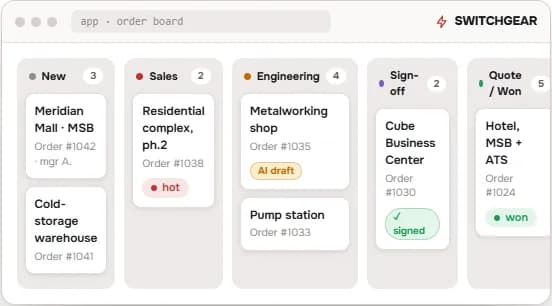
For the panel maker in Quoted by hand. Then not., we built this into the system from day one. The director's dashboard shows time to quote, conversion, the funnel with amounts at each stage and a list of orders sitting in one stage for more than 14 days, each one clickable. A priced quote now takes about two days instead of ten.
68% of B2B executives say customers have become less loyal (Bain). 54% of decision-makers say they would drop a purchase or switch supplier after a bad experience in a channel (McKinsey B2B Pulse, via European Business Magazine). A ten-day quote is a bad experience, even when the price is right.
Calcolatore dei costi
Pick the last 30 requests. Find when each one arrived and when the quote went out. If you cannot find those dates, that is the first finding.
Related: Why your quotes take ten days · What a phone order really costs a manufacturer
Produttore di quadri elettrici (nome coperto da NDA) · Quadri elettrici di bassa tensione · Italia
2 giorni
per un preventivo con i prezzi, invece di circa 10
3 settimane
Tutto aspetta una sola persona.
Trenta minuti. Voi descrivete il problema e il risultato che volete. Noi facciamo domande. Se possiamo aiutarvi, ricevete una email con cosa abbiamo trovato, cosa costruiremmo e quanto costa. Se non possiamo, ve lo diciamo.
Non siete pronti a parlarne? Scoprite quanto vi costa il modo in cui lavorate oggi