Dealers order by WhatsApp. A portal should start there.
Dealers don't resist portals. They resist anything slower than a message. A migration plan in five steps.
Gli articoli sono disponibili solo in inglese.
Ask a manufacturer how its dealers order and the honest answer is often: "WhatsApp, phone, and a PDF price list from last year." Ask why the dealer portal isn't used, if there is one, and you hear that dealers are old-fashioned.
They aren't. They are busy. A message takes ten seconds. A portal that takes three minutes, asks for a login they forgot and shows a price they don't trust will lose to the message every time.
What WhatsApp does well
Before replacing a channel, it's worth being clear about why people chose it.
Speed. One message, one photo, done.
A person. The dealer knows who will answer.
Flexibility. "Same as last time, but two more" works in a message. It rarely works in a form.
A portal that ignores these loses. A portal that keeps them and fixes the rest wins.
What WhatsApp does badly
Prices come from a PDF that may be a year old. Your dealers sell from it anyway.
Stock and lead times are a question, not a fact. Every order triggers a second message.
Nothing is recorded in a way the business can use. You can't see which dealer is growing, which is slipping or which product is suddenly in demand.
Everything depends on the person who answers. When they're away, orders wait.
Five steps to move repeat orders
1. Start with the most frequent order, not the full catalogue. Find the five products each dealer orders most and make reordering them faster than typing a message. One screen, current price, one button.
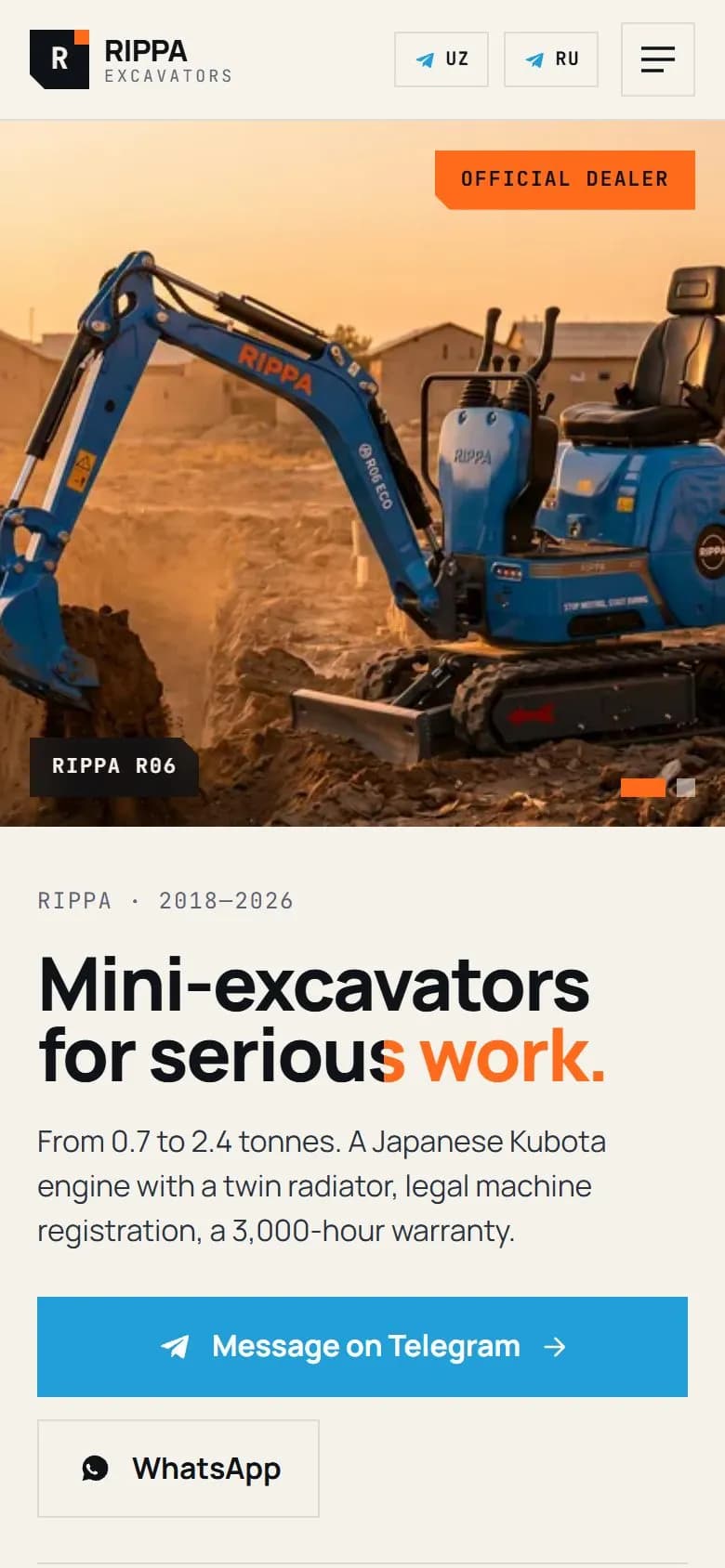
2. Show stock and lead time as facts. For Rippa, a dealer of mini-excavators, we listed parts and consumables explicitly: what is in stock today and what comes from China in one to three weeks. A buyer planning a job needs that before they order, not after. See Nobody trusts a dealer's brochure.
3. Keep the person one tap away. Every page on the Rippa storefront has one-tap contact by Telegram, WhatsApp and phone. The portal does not replace the conversation. It removes the routine part of it.
4. Give dealers something they can't get by message. Their order history, their invoices, current marketing material, and leads. When we built Itochka.pro for Knauf Insulation, retailers appeared on a map so homeowners could find them, and construction calculators turned a homeowner's saved estimate into a direct contact with a nearby store.
5. Measure use, not logins. The useful number is the share of dealers actively recording purchases. On Itochka.pro, 70% of the 1,500 registered stores do.
70%
of 1,500 registered retail stores actively record purchases on Itochka.proThnkers portfolio
The channel conflict fear
38% of companies don't sell online because they fear competing with their own dealers (McKinsey). If the portal sells to end customers behind the dealer's back, the fear is justified.
The alternative is to build the platform for the whole market. Homeowners look for a reliable professional and a convenient store. Professionals look for clients and better terms. Retailers look for traffic. A manufacturer that connects them gives each a reason to use the system, and becomes the place the market does business.
The evidence that this pays: companies that built their own marketplace increased market share in 72% of cases, against 42% of the rest (McKinsey, 2022). Cemex, the building materials company, now runs 65% of its sales through its own digital platform for construction customers (MIT CISR, 2025).
The honest caveat
Professional contractors still buy mostly in store: 91% buy offline, against 29% who order online for delivery (HIRI, 2023). Only one in ten large companies earns 5% or more of revenue from its ecosystems (McKinsey). A portal is not a strategy on its own. It works when it gives each participant something they need from the others.
Usually because it is slower than a message, shows prices or stock they don't trust, or asks for information they don't have. A portal has to beat WhatsApp on speed for the orders dealers place most often.
Should we switch off WhatsApp orders?+
No. Keep one-tap contact on every page. Move repeat orders first and let messaging handle exceptions.
What makes a dealer platform hard to copy?+
The shared record. When dealers, professionals and end customers use the same system, the database of who bought what, where and why becomes an asset no competitor can rebuild quickly.
Dal portfolio
Rippa · Miniescavatori, negozio online del rivenditore · Asia centrale
57,494
messaggi di proprietari trasformati in 60 articoli di cui gli acquirenti si fidano
Siate il luogo dove il vostro mercato si incontra.
→
Diteci cosa manca.
Trenta minuti. Voi descrivete il problema e il risultato che volete. Noi facciamo domande. Se possiamo aiutarvi, ricevete una email con cosa abbiamo trovato, cosa costruiremmo e quanto costa. Se non possiamo, ve lo diciamo.