
Quoted by hand. Then not.
A manufacturer of low-voltage electrical panels came to us with one sentence: could we help unload the director and the engineer? No CRM, no spec, no data model — just a hunch. We built the system the business was missing, in three weeks.
- Services
- Custom SaaS development, AI automation, Data and integrations
- Year
- 2026
Results
~3 wks
from a one-line brief to a working system in production
1,887
catalogue items imported from an 85 MB price list
25
DB migrations, 11 API modules, a tested pricing core
4
roles with separate permissions and calibrated money visibility
What was missing
There was no system at all. Quotes were assembled by hand in Excel across a 20-sheet, 85 MB price list. The pricing logic — what markup applied to which manufacturer, how the assembly coefficient worked — lived entirely in one engineer’s head. The director had no view of the pipeline: which orders were active, which were stalled, what the business was worth at any moment. When the engineer was unavailable, nothing moved.
Before
- No CRM: every order lived in someone’s head and scattered files
- Quotes composed by hand in Excel across a 20-sheet price list
- Pricing and markup formulas locked in one person’s memory
- The engineer buried in repetitive drawing-reading
- The director blind to where deals were and how much was in them
The insight
The real problem wasn’t the engineer’s workload. It was that the engineer’s knowledge, the director’s judgment and the pricing logic that made the business work were all locked inside two people’s heads. That’s structural, not a staffing issue — and bolting the requested AI feature on top would only have produced a more sophisticated version of the same fragility. We didn’t start with the feature. We started with the structure.
What we built
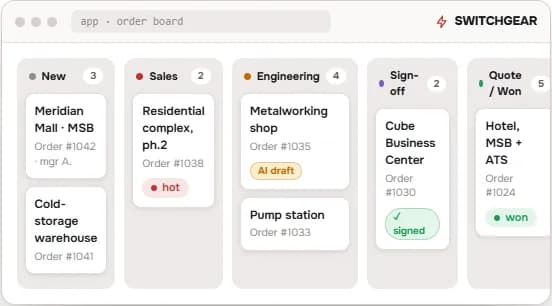
A kanban-style order pipeline — New, Sales, Engineering, Sign-off, Quote, Won — where each of four roles sees and edits only its part, and only the manager, head of sales and director can see money. The 85 MB price list became a structured catalogue of 1,887 items across 223 analog groups, each carrying a risk flag for where a cheaper alternative is safe and where it isn’t. Pricing runs a transparent formula every time: materials, assembly coefficient, cost, markup, VAT. An assistant converts client DWG and PDF drawings, reads them, drafts panel contents against the catalogue and prices the draft — every proposed line tagged with a rationale and a drawing-sheet reference, and confirmed by the engineer before it reaches a quote. Every order produces branded Quote and Specification documents with version history, exporting to Excel and print. The director gets a real-time dashboard: revenue, funnel amounts, conversion, average deal size, and orders stuck in one stage for more than 14 days.
After
- A full order pipeline with roles, statuses and an audit trail
- Automatic pricing: materials → assembly → markup → VAT
- An assistant that drafts panel contents from client drawings for the engineer to confirm
- Branded Quote and Specification documents with version history
- A real-time dashboard so the director sees the business without asking
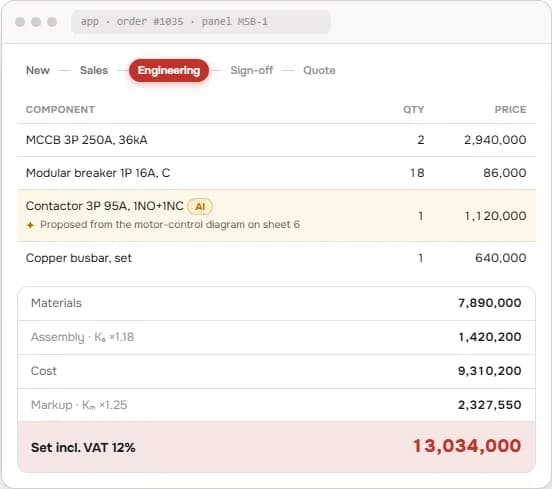
An order's panel contents and automatic price: an AI-proposed line tagged and sourced, then materials, assembly, markup and VAT. 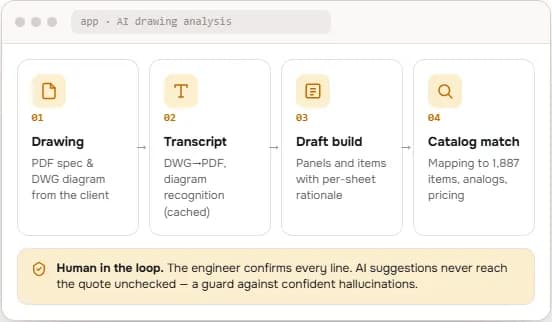
The AI assistant reading client drawings: drawing to transcript to draft build to catalog match, with a human confirming every line.
Stack
Next case
The shop was beautiful. On a phone, it wasn’t.Fabrico
Read the caseContact
Want one of these?
Tell us what is not working. We will tell you what we would do about it.
- Response time
- We answer within one working day.
- How we work
- A remote-first team across EU and US time zones. Everything runs online — your meetings happen where your team already is.