
Rippa · Mini-excavators, dealer storefront · Central Asia · 2026
Nobody trusts a dealer's brochure. They trust other owners.
The buyer had already spent eight months asking other owners. We made that searchable.
- Timeline
- 5–6 weeks
- Market
- Central Asia
57,494
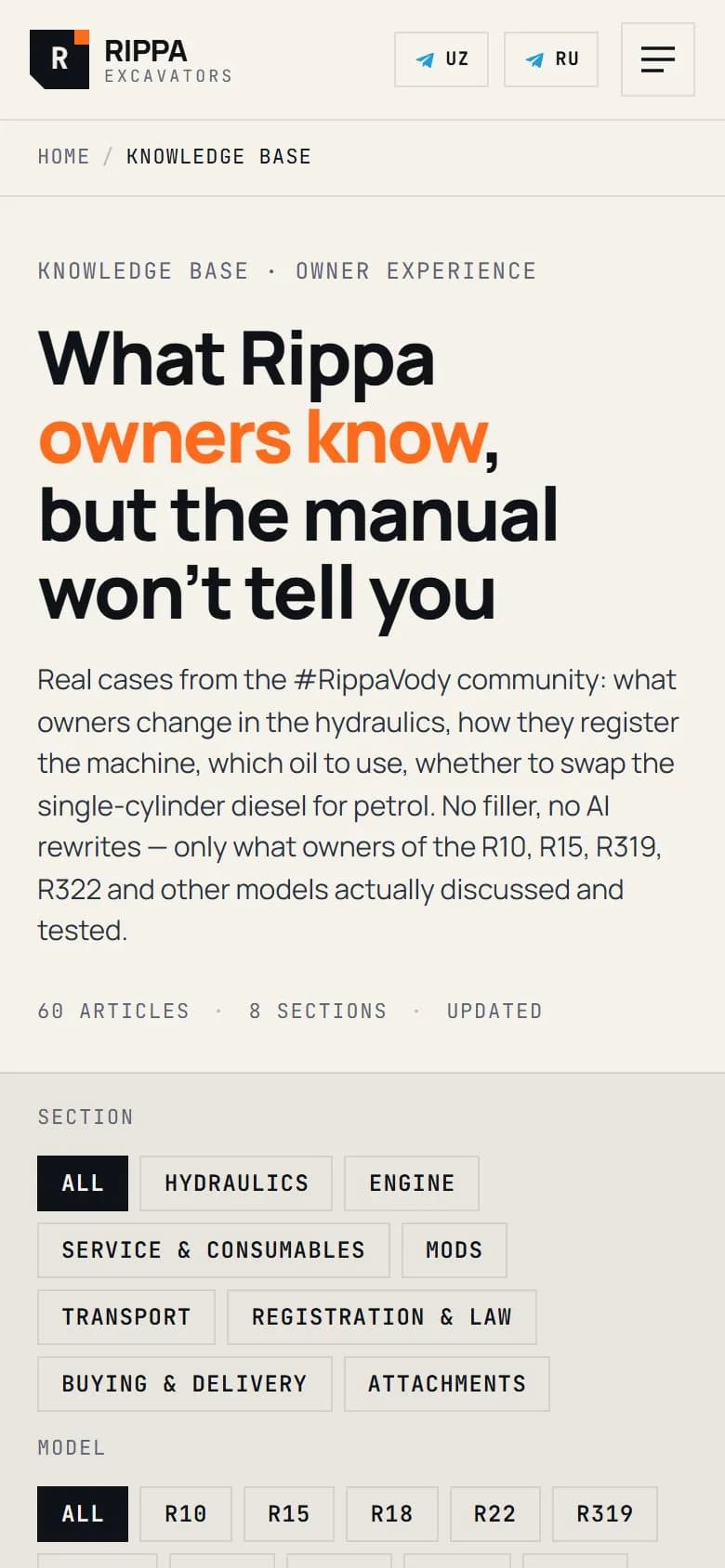
owner messages turned into 60 articles buyers trust
What was missing
Rippa sells Chinese mini-excavators. The buyer is cautious. They're about to spend $6,700 or more on a machine they haven't seen in person, in a market full of clones and unreliable information. Before they call the dealer, they have questions. Which model fits my jobs? What breaks? What does it actually cost to run? Can I register it? How do I haul it?
A brochure site answers none of those questions. Marketing copy isn't trusted, and the buyer knows it.
The dealer had an owners' Telegram community. Eight months of conversations. 383 owners talking about their machines. 57,494 messages covering exactly the questions a buyer asks before committing. That material existed. Nobody had turned it into a website.
The insight
Any dealer can list horsepower. Almost no dealer can show a buyer eight months of real ownership experience, in the owners' own words, with names and dates attached.
That's the defensible asset. Not the catalogue. The community.
We built two things: a proper dealer storefront, and a knowledge base that no competitor could produce without having the same community.
What we built
The storefront
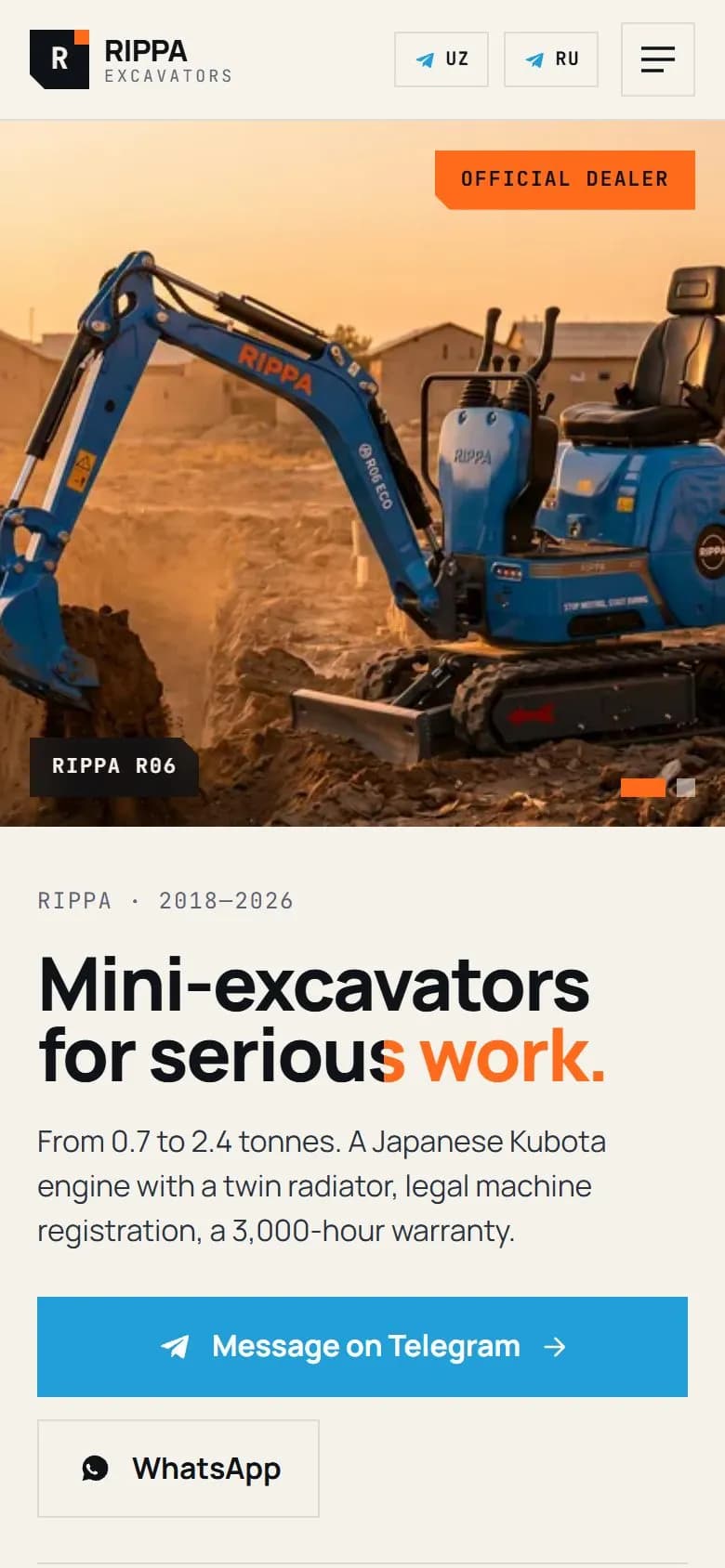
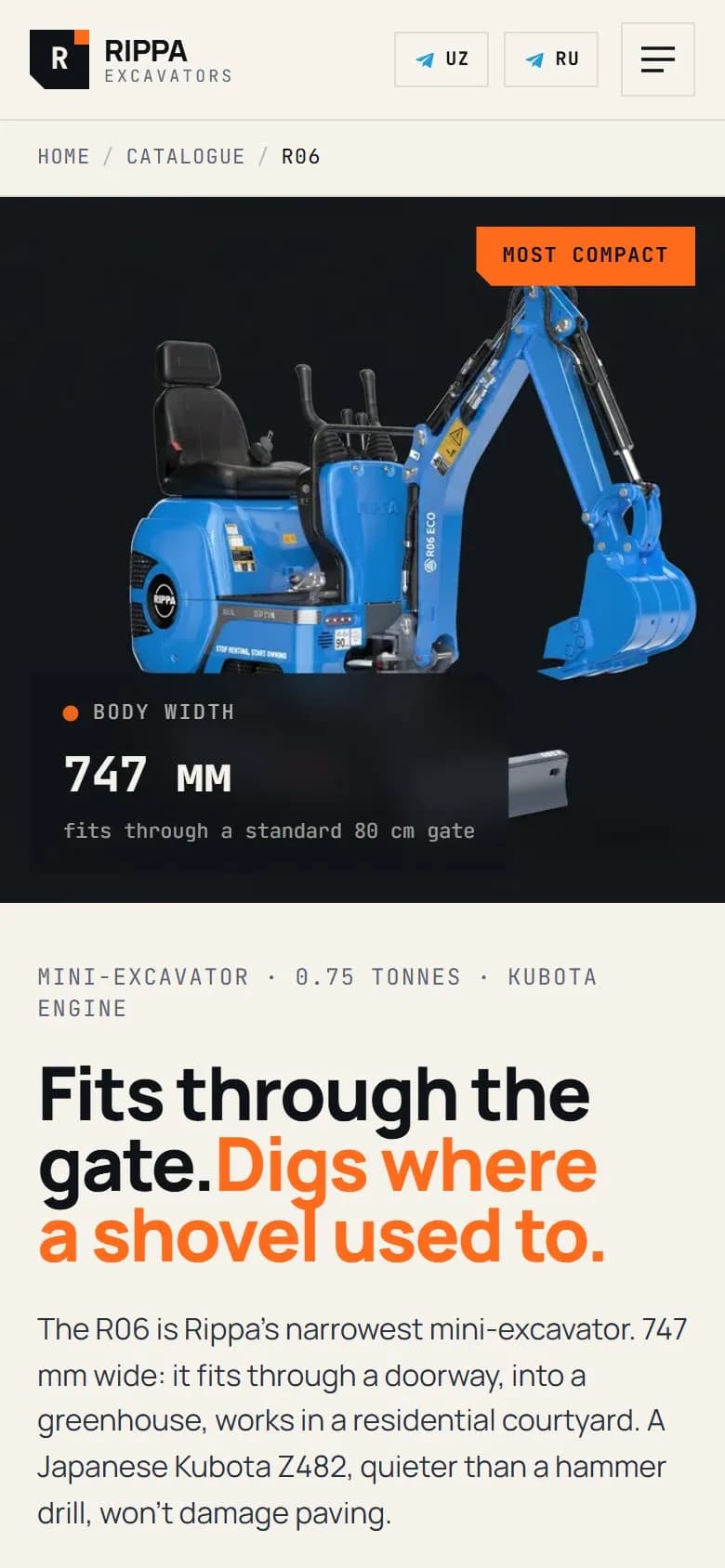
Five model pages, R06 through R22. Full specifications: engine, dimensions, digging performance, equipment list. USD pricing shown clearly. In-stock models carry a badge and a price. Larger models show pre-order status. No "request a quote" walls for the units people actually buy.
A separate flagship page for the R06, the most popular model. Not a spec sheet. A story: six jobs where it pays for itself, use cases, real numbers from real operators. The kind of page that closes a sale with someone who's already decided they want a machine but hasn't decided which one.
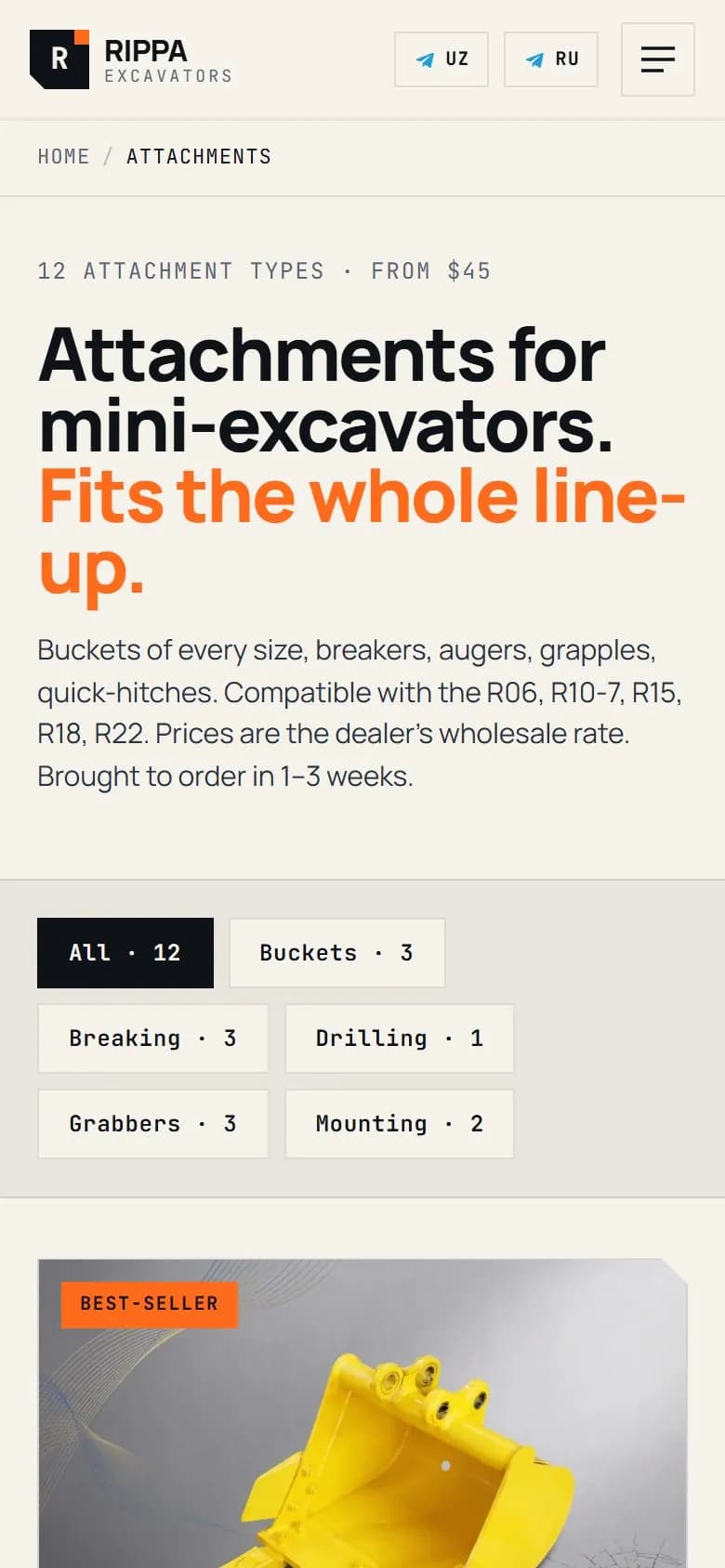
A twelve-type attachments catalogue. Buckets, breaker, auger, grapples, quick-hitch. Each priced. Each marked for compatibility across the full model line.
Parts and consumables listed explicitly: what's in stock today and what comes from China in one to three weeks. A buyer planning a job needs to know this before they buy, not after.
One-tap contact on every page. Telegram, WhatsApp, phone. An embedded map. Payment options: credit, lease, 30% down.
The knowledge base
We obtained the full export of the #RippaVody owners' Telegram group. Eight months of conversations: 57,494 messages, 383 owners, 4,158 photos of machines at work, 1,085 field videos.
A Python pipeline processed the export. BeautifulSoup parsed 58 HTML files into a structured message stream: author, date, media type, reply links. Reply chains were rebuilt into scored threads, each scored for usefulness by text volume, technical keywords, and community reactions. The top 200 threads became article candidates.
Selected threads were rewritten for clarity and readability. Every quote kept its real author, real date, and real message ID. Every article credits the participants. The material is editorial, not invented, and every word is verifiable.
Owner photos were matched to articles automatically: a photo's message, its reply parent, and its children were scanned to establish which topic the photo documents. Images were then optimised to responsive WebP at three sizes.
Sixty articles across eight categories. The categories were chosen because they map directly to the questions a buyer asks before calling the dealer.
Which model: size, weight, digging depth, real-work comparisons between the R319, R327, and R15. Registration: a real documented case of registering a mini-excavator with the Uzbek authorities, the exact process that stops uncertain buyers from committing. Haulage: van, trailer, tow-truck, with the 750kg trailer limit spelled out. Running costs: which oil, which filters, first service checklist, what the factory typically doesn't fill. Earning: what to charge per hour or per shift, with a real job case. Trust: how to identify a genuine Rippa from a clone, the trade-offs of look-alikes.
A buyer can do their entire due diligence on the site. They arrive uncertain. They leave knowing whether the machine fits their work, what ownership costs, and whether the dealer is worth calling.
How we built it
Three languages. Russian and Uzbek-Latin were authored by hand. Uzbek-Cyrillic was generated by a longest-match transliterator built for the project: digraphs, apostrophe letters, protected brand names. One language maintained for free.
After the Vite build, Puppeteer walked every route on all three languages and froze each to static HTML. Google gets fully-rendered pages. Per-language JSON-LD structured data and sitemaps are included. Telegram link previews render correctly.
Route-level code splitting. Lazily loaded knowledge base. Responsive image sets. The site is fast on a phone on mobile data, which is the actual buying context.
The data pipeline is approximately 950 lines of Python across eight scripts: parse, thread, score, backlog, photo-match, image optimisation.
Five to six weeks from start to production.
Results
57,494 community messages analysed from 383 owners. 60 knowledge articles across 8 categories. 4,158 owner photos and 1,085 field videos processed and matched. 3 languages with auto-transliteration for Uzbek-Cyrillic. 100% of routes pre-rendered to static HTML in all three languages. 5 model pages plus a dedicated flagship page for the R06.
What the work included
Storefront development, trilingual content system, Python data pipeline, static pre-render, WooCommerce knowledge base
Stack
Tell us what's missing.
Thirty minutes. You describe the pain and the result you want. We ask questions. If we can help, you get one email with what we found, what we'd build and what it costs. If we can't, we'll say so.